How to Get a PADI C-Card (Diving License) | Cost, Process & My Experience
Want to try diving but not sure what to prepare first? I got certified myself in Okinawa's Kerama Islands and now have around 30 logged dives plus an Advanced certification — here's how to get a PADI C-card (diving license), roughly what it costs, and how long it takes, along with my own experience.
In short, a C-card takes 3 steps — knowledge, confined water, and open water — and can be earned in as little as 2-3 days, or comfortably paired with a trip.
What Exactly Is a "C-Card"?
People often call it a diving "license," but strictly speaking it isn't a license issued by a country or government — it's a Certification Card (C-card) issued by a private diving organization like PADI, NAUI, or SSI. Dive shops anywhere in the world require you to show this C-card to rent gear or join a guided fun dive, so in practice it functions like a license — "you can't dive without it." PADI in particular is the world's largest certifying organization, with the largest number of shops offering its courses.
What Are the Types of Diving License, and How Do You Step Up?
C-cards come in levels, and the higher the license, the greater the depth and range of conditions you're certified to dive in.
- Open Water Diver (OWD): the entry-level license you get first. Certified to dive to a maximum depth of 18m
- Advanced Open Water Diver (AOW): extends your depth limit to 30m. Earned by completing 5 specialty dives, such as navigation, deep, and drift
- Rescue Diver: a license focused on safety management — covers handling your own trouble plus how to help rescue other divers
I stepped up through these in exactly this order myself. I got my Open Water certification in Okinawa's Kerama Islands, then later earned my Advanced certification mainly in Shakotan (Hokkaido) using a drysuit. I'm at around 30 logged dives now, and I'm taking the Rescue Diver course on the 9th of this month.
What Are the 3 Steps to Getting a C-Card?
- Knowledge development (eLearning): build your knowledge with text and video on your phone or computer, answering quizzes at the end of each chapter. You can go at your own pace before ever visiting the shop
- Confined water training: in a pool or calm, shallow sea, repeatedly practice basic skills like clearing your mask, regulator recovery, and achieving neutral buoyancy
- Open water dives: in the actual sea, typically over 2 days and about 4 dives, put the skills you've learned into practice. Once this is done, your C-card is issued
How Much Does It Cost, and How Long Does It Take?
The cost of a PADI Open Water certification varies by shop and region, but including teaching materials and gear rental, it's roughly ¥40,000–¥70,000. If you finish the knowledge development portion via eLearning beforehand, you can get certified in 2-3 days on-site.
Experience #1: Getting Open Water Certified in Kerama
The first place I got certified was the Kerama Islands, about an hour by boat from mainland Okinawa. In the blue, exceptionally clear water known as "Kerama Blue," what stuck with me most wasn't the formality of a course but the freshness and fun of being able to breathe underwater. Practicing in the pool made me a bit nervous, but once I got out into the actual sea, watching schools of fish and coral reefs during the practice dives, I earned my license before I knew it.
Experience #2: Taking Advanced in a Drysuit in Shakotan
For Advanced, things flipped completely — I got certified wearing a drysuit in the cold waters of Shakotan, Hokkaido. The gear and buoyancy feel were completely different from Okinawa's wetsuit, and I was thrown off at first, but that came with a clarity and a different underwater scenery you can't experience in warm water.
Night diving stood out in particular. Going into the pitch-dark sea after sunset was genuinely quite frightening at first, and relying only on the light of my torch made me deeply uneasy. But once I actually dove, I got to see creature behavior you never see during the day, and plankton drawn to the light — a completely different underwater world that ended up being far more fun than scary.
Another thing the Advanced course gave me was a firsthand understanding that "I myself could get into trouble underwater." Losing track of your own position for even a moment, in poor visibility or darkness, feels completely different when you've actually experienced it versus just knowing about it intellectually. Learning that fear firsthand is one of the reasons I later decided to take the Rescue Diver course.
Advice for Anyone Just Starting Out?
- Getting certified while traveling is a good idea: getting your C-card somewhere like Kerama turns it into "a travel memory" rather than "a course"
- Don't shy away from specialties like night diving: it might be scary at first, but it's a valuable experience that shows you a completely different world from daytime
- Don't underestimate how the sea can turn dangerous: diving is a fun hobby, but the underwater environment can turn into an out-of-the-ordinary situation quickly. Learning the real risks properly as you step up is the key to diving safely for a long time
- Keep a logbook: recording your dive count, depth, water temperature, and so on helps confirm you meet the requirements for higher certifications, and is also a fun way to look back on your own progress
Summary
Getting a C-card takes 3 steps — knowledge, confined water, and open water — and can be earned in as little as 2-3 days, or comfortably paired with a trip. I personally went from Open Water certification in Kerama all the way to drysuit training and night diving in Shakotan. Start with Open Water Diver and take your first step into a new world.
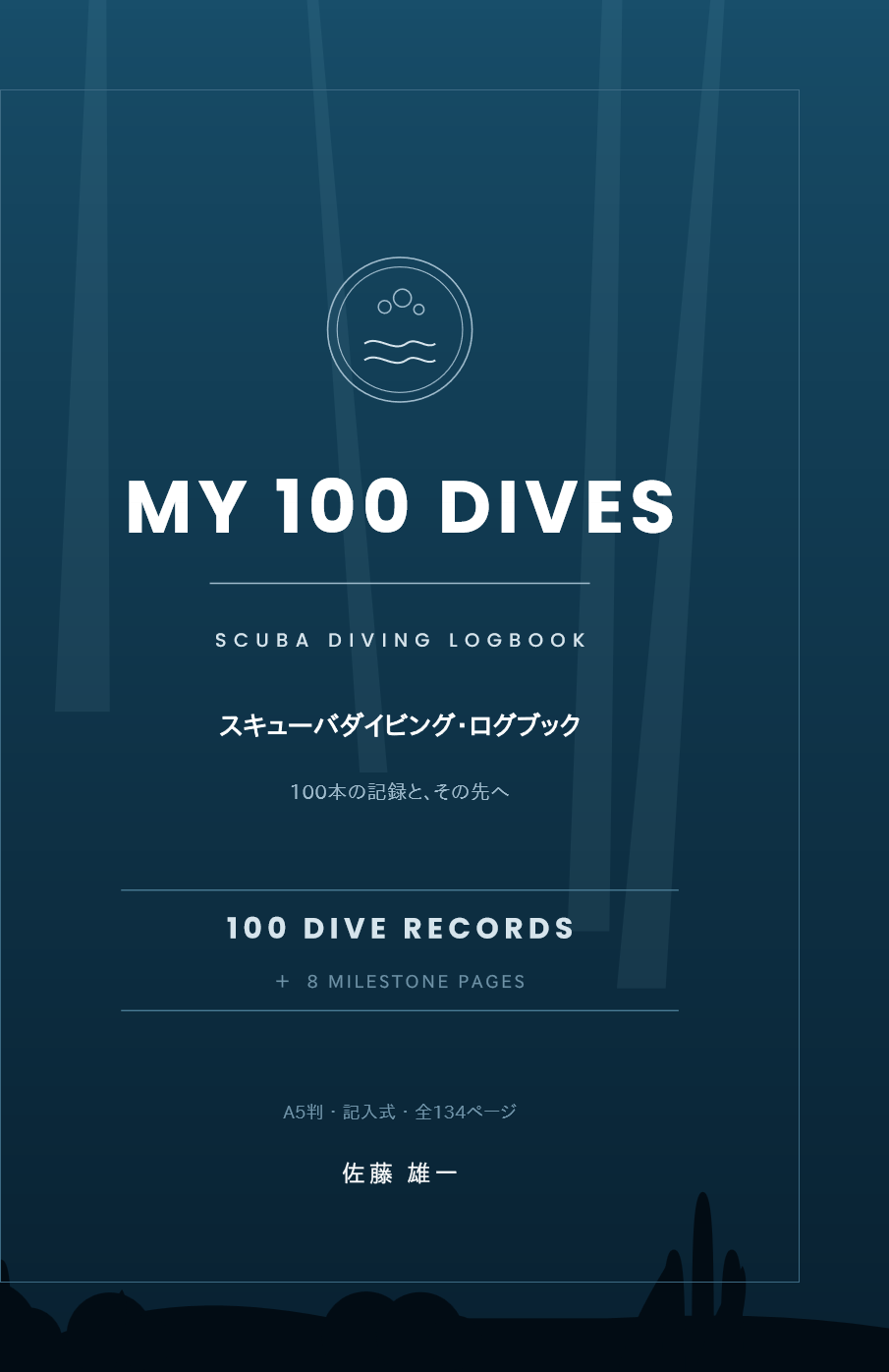
MY 100 DIVES: Scuba Diving Logbook
A fill-in logbook covering every field needed to document your dive count — depth, water temperature, remaining pressure, visibility, and more. Includes 100 dive-record pages, milestone pages, a gear checklist, and a bilingual (Japanese/English) marine life checklist. (Japanese-language book.)
📖 Read on Kindle for ¥1,628Frequently Asked Questions
Q. Can anyone get a C-card?
A. Each certifying organization sets its own conditions around age and swimming ability, but as long as you're in reasonably good health, most people can get certified. Check with the shop you're training with for exact requirements.
Q. Can I get a C-card if I can't swim well?
A. The course teaches you to get comfortable in water starting from the basics, but a certain level of swimming ability is required. If you're unsure, it's worth talking to the shop beforehand.
Q. Does a C-card from an organization other than PADI still work?
A. C-cards from other certifying organizations like NAUI or SSI are also generally accepted at dive shops worldwide.
Q. Does a C-card expire?
A. The C-card itself doesn't expire, but if you haven't dived in a long time, a skills refresher course is recommended.
Q. Does the cost include gear rental?
A. It varies by shop. It's worth checking before signing up whether gear rental and boat diving fees are included in the price.